We use cookies to offer you a better browsing experience, analyze site traffic and personalize content. By using this site, you agree to our use of cookies. Privacy Policy

Product

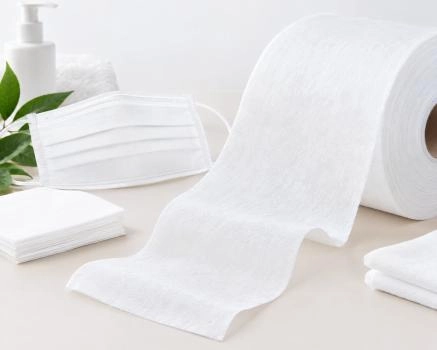
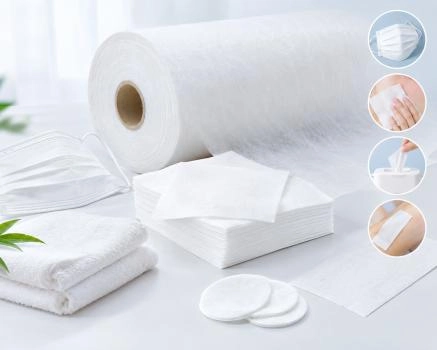
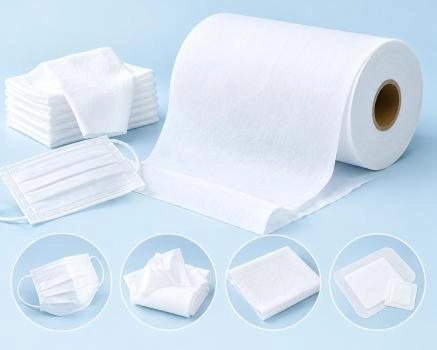
We offer a diverse range of products across multiple fields, including nonwoven wipes, industrial electronic products, high-end beauty essentials, jacquard electrostatic dust removal products, civil cleaning wet wipes, industrial synthetic leather fabrics, medical and health supplies, and multi-purpose products for automotive noise reduction.

Spunlace Nonwoven Manufacturers

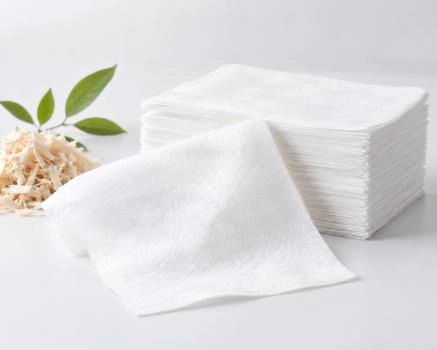
Spunlace nonwoven fabric — also called hydroentangled nonwoven — is one of the most versatile engineered textiles in modern manufacturing. Produced by directing high-pressure water jets onto a loosely laid fiber web, the process mechanically entangles individual fibers without relying on chemical binders, thermal bonding, or adhesives. The result is a material that combines the softness of woven cloth with the structural consistency of technical textiles, making it suitable for a remarkably wide range of end uses — from delicate facial care products to load-bearing automotive interior components.

What Makes Spunlace Different from Other Nonwovens

Nonwoven fabrics can be consolidated through several methods: thermal bonding, chemical bonding (latex or resin binders), needle punching, and hydroentanglement. Each produces different structural and surface characteristics.

In the spunlace process, a fiber web — typically carded or cross-lapped — passes under a series of high-pressure water jet manifolds operating at 30 to 200 bar depending on fiber type and target weight. The jets cause fibers to wrap around and interlock with each other, then drain away through the forming belt. Because no foreign material is introduced into the fabric structure, spunlace products have superior softness, drape, and skin compatibility compared to chemically bonded alternatives.

Key technical advantages:

Binder-free structure — no residual chemical in the fabric

High specific surface area — supports liquid absorption and release

Tunable surface texture — achieved through patterned forming belts or embossing

Compatibility with viscose, polyester, polypropylene, wood pulp, lyocell, and blends

Scalable basis weight — typically 28 gsm to 120 gsm

Fiber Composition and Its Effect on Performance

Viscose (Rayon)

Viscose is a cellulose-derived fiber with high moisture regain (up to 11% under standard conditions), making it ideal for absorbent applications. It is frequently blended with polyester to maintain structural integrity under wet conditions. Our facial mask nonwoven fabric and hydrophilic spunlace face towels are formulated around viscose-rich compositions for this reason.

Polyester (PET)

Polyester fibers are inherently strong, dimensionally stable, and moisture-resistant. In pure polyester spunlace, the result is a stiff, durable, low-lint substrate suited for technical applications. Our polyester nonwoven wall cloth, nonwoven curtain substrate, car roof lining nonwoven material, and spunlace leather substrate fabric all use 100% polyester fiber to maximize mechanical performance.

Viscose / Polyester Blends

The 70% viscose / 30% polyester blend is the most widely specified composition in the medical and hygiene sector. Viscose provides absorbency for managing wound exudate; polyester prevents the fabric from tearing when saturated. Our medical spunlace nonwoven for wound dressings is manufactured to this exact 70/30 ratio.

Wood Pulp / Viscose Blends

Wood pulp fiber introduces high absorbency and a soft texture at lower cost. When blended with rayon through spunlace, it produces a fabric that retains excellent wet strength while remaining cost-effective for high-volume cleaning applications. Our viscose spunlace pulp cleaning cloths follow this approach, producing an eco-friendly, biodegradable option for household and janitorial use.

Polyester / Viscose Blends for Functional Surfaces

When a surface requires both scrubbing power and liquid absorbency, a balanced polyester/viscose blend with an embossed surface delivers the right combination. Polyester provides hardness to dislodge grease; viscose handles liquid uptake. Our wavy-textured spunlace kitchen wipes are produced with an additional sizing treatment that reduces fiber shedding and improves durability through repeated wringing cycles.

Personal Care and Beauty Applications

Sheet masks are one of the largest volume applications for spunlace nonwoven globally. The substrate must hold a large volume of serum without dripping, maintain conformal contact with facial contours, and feel comfortable during wear. Our facial mask nonwoven fabric is engineered with a high-absorbency viscose-based composition and controlled web uniformity to ensure consistent serum distribution across the entire sheet surface.

Hair removal strips require a fabric surface with a controlled friction coefficient — high enough to grip and remove fine hair, but not so abrasive as to cause skin irritation. Our spunlace depilatory cloth achieves this through precisely controlled hydroentanglement parameters that produce a targeted surface texture, eliminating the need for added coatings or abrasives.

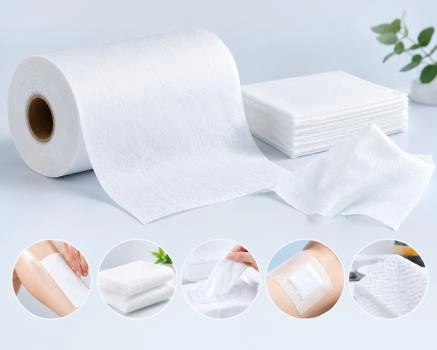
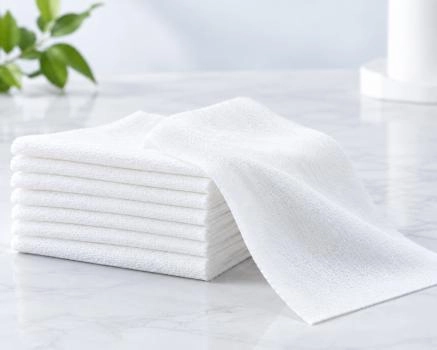
Disposable face towels made from hydrophilic spunlace nonwoven are a rapidly growing skincare category. The hydrophilic treatment ensures rapid water uptake and release, while the spunlace structure provides a lint-free, non-scratching surface appropriate for sensitive and post-procedure skin care routines.

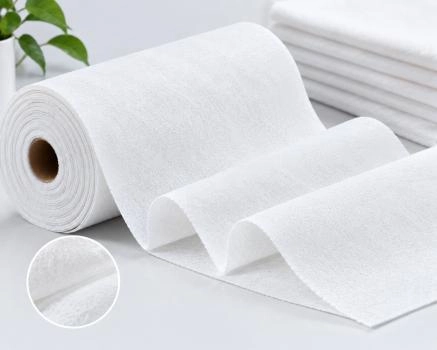
Wet wipe substrates must survive full saturation and sealed packaging without losing structural integrity. Our spunlace nonwoven for wipes uses premium cellulose fiber to deliver a soft yet grippy surface that enables effective cleansing with a single wipe stroke.

Breathability and filtration are not mutually exclusive when the base material is correctly engineered. Our polyester spunlace face mask cloth balances air permeability with physical barrier performance, making it appropriate for extended-wear reusable mask applications.

Medical and Healthcare Applications

Medical-grade nonwoven for wound dressing applications must meet requirements beyond typical hygiene products:

Absorbency rate and capacity — rapidly absorb wound exudate and retain it away from the wound surface to maintain a moist healing environment.

Wet tensile strength — dressings are repositioned and removed in moist conditions; the fabric must not tear or fragment.

Low linting — fiber particles shed into a wound site can trigger inflammatory responses and complicate healing.

Biocompatibility — the absence of chemical binders in spunlace construction removes a major category of potential irritants and allergens.

The 70/30 viscose-polyester composition addresses each of these requirements. Basis weight tolerance is held within narrow limits to ensure consistent clinical performance across production batches.

Home Decoration and Interior Applications

Wallcovering substrate fabric must be dimensionally stable under adhesive application and accept print inks evenly. Our polyester nonwoven wall cloth provides a smooth, uniform surface free of weave-pattern shadows. Its spunlace structure is isotropic — tensile properties consistent in both machine and cross directions — which prevents the differential shrinkage that causes bubbles, blistering, and seam lifting during installation.

Our nonwoven fabric for curtains is produced from 100% polyester spunlace with a proprietary sizing treatment that enhances rigidity and drape. The sizing creates a crisp hand that allows the fabric to form and hold pleats consistently, while the spunlace base accepts ink and dye evenly for high-definition print reproduction.

Automotive and Industrial Applications

Automotive headliner materials operate under large temperature fluctuations, continuous vibration, and UV exposure, while adhering reliably to complex curved surfaces. Our car roof lining nonwoven material is engineered from 100% polyester spunlace with an ultra-lightweight construction that contributes to vehicle weight reduction without sacrificing surface uniformity or finish quality.

Synthetic leather requires a base fabric that accepts polyurethane resin impregnation uniformly, maintains dimensional stability through the coating process, and provides tear strength to support the surface layer in use. Our spunlace leather substrate fabric provides exceptional tear strength, controlled uniform porosity, and excellent moldability. The uniform porosity ensures even resin penetration — a factor that directly determines the consistency and long-term durability of the finished synthetic leather.

Technical Specifications

Parameter Range / Options
Basis weight 28 gsm – 120 gsm
Fiber composition 100% viscose, 100% polyester, 70/30 viscose/PET, wood pulp/viscose, PET/viscose blends
Production width Up to 3,200 mm (cross-lapped lines)
Surface texture Smooth, patterned, embossed, sizing-treated
Hydrophilicity Standard or enhanced-wettability treatment
Optional finishing Sizing, anti-static, anti-bacterial, dyeing, printing

Product Selection Guide

Maximum skin softness → viscose-dominant, hydrophilic treated, 40–60 gsm: facial mask nonwoven fabric / hydrophilic face towels

Wet strength + high absorbency → 70/30 viscose/PET blend: medical wound dressing fabric

Biodegradable household cleaning → wood pulp/viscose blend: pulp cleaning cloths

Heavy-duty kitchen scrubbing → embossed PET/viscose + sizing: wavy-textured kitchen wipes

Technical substrates (dimensional stability) → 100% polyester spunlace: wall cloth / curtain substrate / car roof lining / leather base fabric

Customize Exclusive Plans to Meet Your Personalized Product Needs


We have 2 advanced spunlace production lines: one for high-quality products, the other for new product R&D and production. With one-stop services, we independently control production requirements, boasting advantages in cost, quality control and product diversification.


We develop products with special specs and uses based on user and market needs, while providing optimal service and support. We also offer custom production with special processes as required, including water repellency, flame retardancy, anti-aging, anti-static, anti-bacterial, anti-ultraviolet and special composite properties.